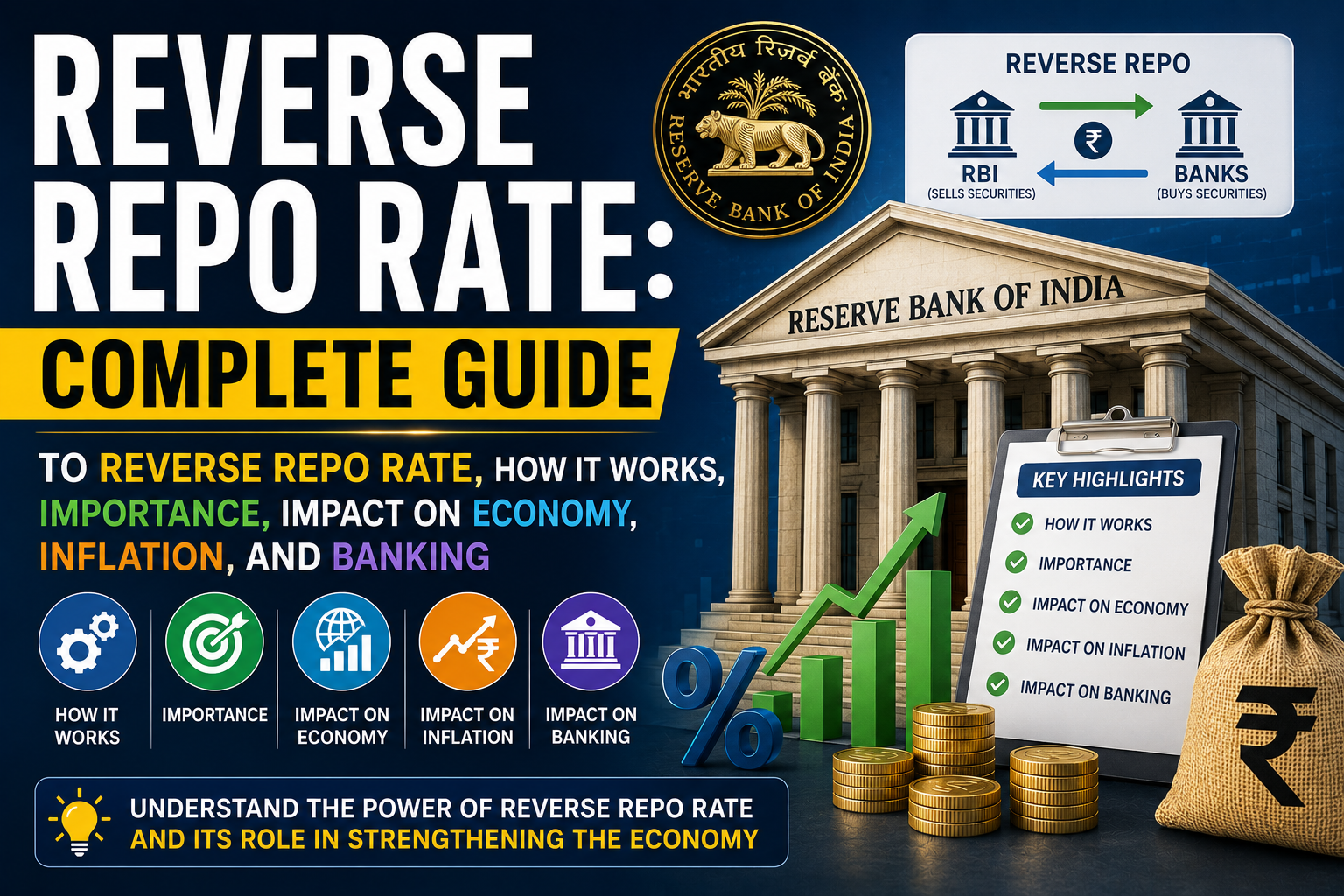
The reverse repo rate is one of the most important tools used by central banks to manage liquidity and maintain economic stability. Although many people hear about repo rate during RBI monetary policy announcements, the reverse repo rate is equally important in the banking and financial system.
The reverse repo rate directly affects:
- Banking liquidity
- Inflation control
- Economic stability
- Interest rates
- Loan availability
- Financial markets
- Savings and investments
In India, the reverse repo rate is controlled by the Reserve Bank of India (RBI) as part of its monetary policy framework.
Understanding reverse repo rate is important for:
- Students
- Investors
- Bankers
- Business owners
- Loan borrowers
- People interested in economics and finance
In this detailed guide, we will explain everything about reverse repo rate, including:
- What is reverse repo rate?
- How does reverse repo rate work?
- Why is reverse repo rate important?
- Reverse repo rate and inflation
- Reverse repo rate and banking liquidity
- Difference between repo rate and reverse repo rate
- Reverse repo rate and economy
- Impact on loans and investments
- Reverse repo rate in India
- Advantages and disadvantages
- Future of reverse repo rate policy
By the end of this article, you will fully understand how reverse repo rate works and why it matters in the economy.
What Is Reverse Repo Rate?
Reverse repo rate is the interest rate at which the central bank borrows money from commercial banks for short-term periods.
In India, the Reserve Bank of India borrows excess funds from banks and pays interest on those deposits.
The interest paid by the RBI to banks is called the reverse repo rate.
The term “reverse” is used because it is the opposite of repo rate.
In repo rate:
- RBI lends money to banks.
In reverse repo rate:
- Banks lend money to RBI.
Reverse repo rate is mainly used to absorb excess liquidity from the banking system.
How Does Reverse Repo Rate Work?
Understanding reverse repo rate becomes easier when we look at the process step by step.
Step 1: Banks Have Excess Funds
Commercial banks sometimes have extra money that is not being used for lending.
This may happen when:
- Loan demand is low
- Customers deposit more money
- Economic activity slows
Step 2: RBI Offers Reverse Repo Facility
The RBI allows banks to deposit excess funds with the central bank.
Step 3: RBI Pays Interest
The RBI pays interest to banks on these deposits.
This interest rate is called the reverse repo rate.
Step 4: Liquidity Is Absorbed
Money temporarily moves from banks to the RBI.
This helps reduce excess liquidity in the economy.
Why Is Reverse Repo Rate Important?
The reverse repo rate is an important monetary policy tool.
It helps central banks:
- Control inflation
- Manage liquidity
- Maintain financial stability
- Influence interest rates
- Regulate money supply
Without reverse repo rate management, excess money in the economy could create inflationary pressure.
Reverse Repo Rate and Liquidity Management
Liquidity means the availability of money in the banking system.
Managing liquidity is one of the primary purposes of reverse repo rate.
High Liquidity Situation
When banks have too much money:
- Lending may rise excessively
- Spending may increase rapidly
- Inflation risk grows
In such situations, RBI may increase the reverse repo rate.
Higher reverse repo rate encourages banks to deposit more funds with RBI instead of lending aggressively.
Low Liquidity Situation
When liquidity is low, RBI may reduce the reverse repo rate.
This discourages banks from parking money with RBI and encourages lending.
Reverse Repo Rate and Inflation
Inflation refers to the rise in prices of goods and services.
The reverse repo rate helps control inflation indirectly.
When Inflation Is High
RBI may increase reverse repo rate.
As a result:
- Banks deposit more money with RBI
- Money supply in market reduces
- Lending slows
- Spending decreases
- Inflation pressure reduces
When Inflation Is Low
RBI may reduce reverse repo rate.
As a result:
- Banks prefer lending instead of parking money with RBI
- Market liquidity increases
- Economic activity improves
Thus, reverse repo rate helps balance inflation and growth.
Difference Between Repo Rate and Reverse Repo Rate
Many people confuse repo rate and reverse repo rate.
Here is the major difference.
| Repo Rate | Reverse Repo Rate |
|---|---|
| RBI lends money to banks | Banks lend money to RBI |
| Used to inject liquidity | Used to absorb liquidity |
| Banks pay interest to RBI | RBI pays interest to banks |
| Encourages liquidity in market | Reduces excess liquidity |
Both are essential tools of monetary policy.
Reverse Repo Rate and Banking System
The reverse repo rate has a major impact on commercial banks.
Higher Reverse Repo Rate
When reverse repo rate increases:
- Banks earn more by depositing money with RBI
- Lending activity may reduce
- Liquidity in market decreases
Lower Reverse Repo Rate
When reverse repo rate decreases:
- Depositing money with RBI becomes less attractive
- Banks prefer lending money
- Liquidity in economy increases
Thus, reverse repo rate influences banking behavior significantly.
Reverse Repo Rate and Loan Interest Rates
The reverse repo rate indirectly affects loan interest rates.
Higher Reverse Repo Rate
Banks may lend cautiously.
This can:
- Reduce loan availability
- Increase borrowing cost
Lower Reverse Repo Rate
Banks may increase lending.
This can:
- Improve credit availability
- Support economic activity
Although repo rate has a more direct impact on loans, reverse repo rate also influences overall banking conditions.
Reverse Repo Rate and Economic Growth
The reverse repo rate influences economic growth by affecting liquidity and lending.
Lower Reverse Repo Rate Supports Growth
When RBI lowers reverse repo rate:
- Banks lend more
- Businesses get easier credit
- Consumer spending rises
- Economic activity improves
Higher Reverse Repo Rate Slows Excessive Growth
When liquidity becomes excessive, RBI may increase reverse repo rate to prevent overheating.
Reverse Repo Rate and Financial Markets
Financial markets closely monitor reverse repo rate changes.
Impact on Stock Market
Higher reverse repo rate may reduce liquidity available for investments.
This can negatively affect stock market sentiment.
Impact on Bond Market
Interest rate changes also affect bond yields and investor behavior.
Reverse Repo Rate in India
In India, the Reserve Bank of India manages reverse repo rate under the monetary policy framework.
The Monetary Policy Committee (MPC) regularly reviews economic conditions and determines policy rates.
The reverse repo rate became especially important during periods of excess liquidity in the banking system.
Reverse Repo Rate During Economic Crisis
During economic crises, reverse repo rate becomes a critical tool.
During Economic Slowdown
RBI may reduce reverse repo rate to:
- Encourage lending
- Improve liquidity
- Boost economic activity
During High Inflation or Excess Liquidity
RBI may increase reverse repo rate to:
- Absorb surplus funds
- Reduce inflationary pressure
- Maintain financial stability
Thus, reverse repo rate helps manage changing economic conditions.
Reverse Repo Rate and COVID-19 Period
During the COVID-19 pandemic, central banks worldwide used monetary policy aggressively.
In India:
- RBI reduced policy rates
- Liquidity support increased
- Reverse repo rate adjustments encouraged banks to lend more
These measures aimed to support businesses and economic recovery.
Reverse Repo Rate and Savings
Reverse repo rate indirectly affects savers.
Higher Reverse Repo Rate
Banks may offer better deposit rates.
Lower Reverse Repo Rate
Deposit interest rates may remain lower.
Thus, savers and fixed deposit investors may feel the impact indirectly.
Reverse Repo Rate and Consumer Spending
Liquidity conditions affect consumer behavior.
More Liquidity
- Easier loans
- Higher spending
- Increased consumption
Less Liquidity
- Reduced borrowing
- Lower spending
- Slower demand growth
Reverse repo rate indirectly shapes consumer activity in the economy.
Reverse Repo Rate and Businesses
Businesses depend heavily on banking liquidity.
Lower Reverse Repo Rate Benefits Businesses
- Easier access to loans
- Better working capital availability
- Expansion opportunities
Higher Reverse Repo Rate Creates Tight Conditions
- Credit availability may reduce
- Borrowing costs may rise
- Business growth may slow
Large businesses monitor monetary policy decisions closely.
Advantages of Reverse Repo Rate
Reverse repo rate offers several benefits to the economy.
Controls Excess Liquidity
Helps absorb surplus money from banks.
Supports Inflation Control
Reduces inflationary pressure when needed.
Maintains Financial Stability
Helps manage banking system liquidity.
Strengthens Monetary Policy
Provides RBI additional policy flexibility.
Improves Economic Balance
Helps balance growth and inflation.
Disadvantages of Reverse Repo Rate
Although useful, reverse repo rate also has some limitations.
Higher Reverse Repo Rate May Slow Growth
Banks may reduce lending activity.
Lower Reverse Repo Rate May Increase Inflation
Excess liquidity can increase inflation risk.
Indirect Impact on Public
Common people may not immediately understand its effects.
Dependence on Banking Transmission
Policy effectiveness depends on banking response.
Reverse Repo Rate and Monetary Policy
Reverse repo rate is a major component of monetary policy.
Monetary policy refers to actions taken by central banks to manage:
- Inflation
- Money supply
- Interest rates
- Economic stability
The RBI uses reverse repo rate along with:
- Repo rate
- Cash Reserve Ratio (CRR)
- Statutory Liquidity Ratio (SLR)
- Open market operations
These tools work together to regulate the economy.
Reverse Repo Rate vs Bank Rate
People often confuse reverse repo rate with bank rate.
Here is the difference.
| Reverse Repo Rate | Bank Rate |
| RBI borrows from banks | RBI lends to banks |
| Short-term liquidity management | Long-term monetary control |
| Used to absorb liquidity | Used to control credit |
Both are important but serve different purposes.
Reverse Repo Rate Transmission
Reverse repo rate transmission means how effectively banking behavior changes after policy adjustments.
Effective Transmission
Banks respond quickly to RBI signals.
Weak Transmission
Banks may continue existing lending patterns.
Strong transmission improves policy effectiveness.
Future of Reverse Repo Rate Policy
The future of reverse repo rate policy may become more data-driven and technology-focused.
Possible future developments include:
- AI-based economic forecasting
- Faster monetary transmission
- Digital financial monitoring
- Advanced liquidity management systems
- Better inflation targeting mechanisms
As economies evolve, central banks will continue improving monetary policy frameworks.
Reverse Repo Rate and Global Economy
Central banks worldwide use reverse repo-style mechanisms.
Global economic conditions often influence domestic monetary policy.
Factors such as:
- Global inflation
- Oil prices
- Currency fluctuations
- International interest rates
can impact reverse repo rate decisions.
Important Tips for Investors and Borrowers
Understanding reverse repo rate can help make smarter financial decisions.
Monitor RBI Policy Announcements
Policy decisions affect markets and interest rates.
Understand Liquidity Conditions
Liquidity impacts investments and borrowing.
Track Inflation Trends
Inflation often influences policy rates.
Maintain Financial Flexibility
Interest rate cycles can change financial conditions quickly.
Diversify Investments
Different asset classes react differently to monetary policy.
Role of Reverse Repo Rate in Financial Stability
Financial stability is one of the key goals of central banks.
Reverse repo rate helps prevent:
- Excessive liquidity
- Financial bubbles
- Uncontrolled inflation
- Banking instability
Proper liquidity management supports long-term economic health.
Final Thoughts
The reverse repo rate is one of the most important tools used by the Reserve Bank of India to manage liquidity and maintain economic stability.
It helps regulate:
- Banking liquidity
- Inflation
- Interest rates
- Economic growth
- Financial stability
Although reverse repo rate may seem like a technical banking term, its impact reaches the entire economy.
Changes in reverse repo rate influence:
- Banks
- Businesses
- Investors
- Consumers
- Borrowers
Understanding reverse repo rate helps individuals better understand how monetary policy works and how central banks manage economic conditions.
As India’s financial system continues to modernize, monetary policy tools like reverse repo rate will remain extremely important for balancing growth, inflation, and financial stability.
Whether you are an investor, student, entrepreneur, or someone interested in economics, learning about reverse repo rate can improve your financial awareness and understanding of the economy.
