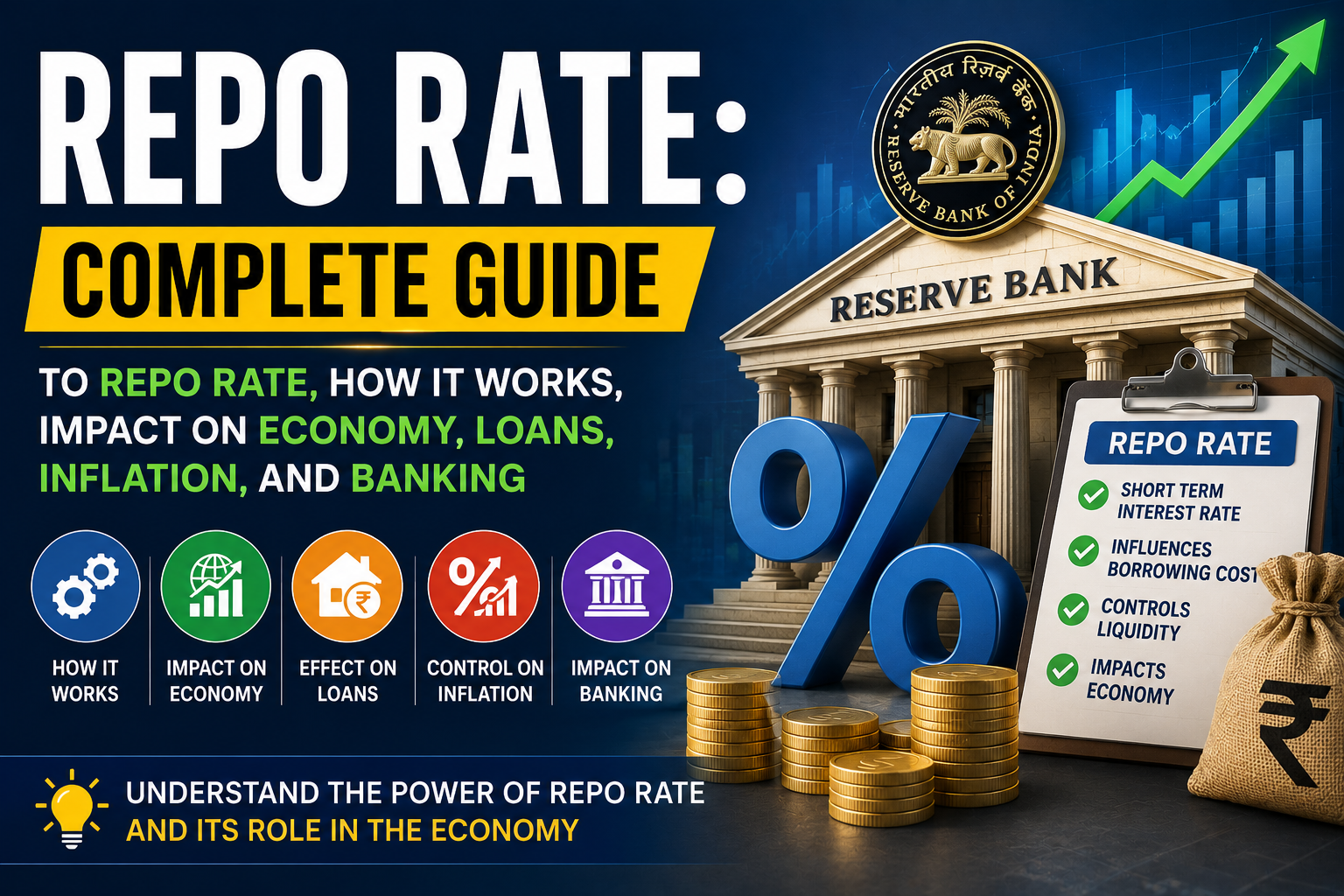
The repo rate is one of the most important financial and economic terms in the banking system. Whether you are a student, investor, business owner, home loan borrower, or someone interested in the economy, understanding repo rate is extremely important.
The repo rate directly affects:
- Home loan EMIs
- Personal loan interest rates
- Inflation
- Economic growth
- Banking liquidity
- Investment markets
- Consumer spending
Whenever the central bank changes the repo rate, its impact can be seen across the entire economy.
In India, the repo rate is controlled by the Reserve Bank of India (RBI), which uses it as a major monetary policy tool.
In this detailed guide, we will explain everything about repo rate, including:
- What is repo rate?
- How does repo rate work?
- Why is repo rate important?
- Repo rate and inflation
- Repo rate and loans
- Repo rate and banks
- Reverse repo rate
- Impact on economy
- Repo rate in India
- Advantages and disadvantages
- Future of repo rate policy
By the end of this article, you will have a complete understanding of repo rate and its role in the economy.
What Is Repo Rate?
Repo rate is the interest rate at which the central bank lends money to commercial banks for short-term needs.
In India, the Reserve Bank of India provides loans to banks when they need funds.
Banks borrow money from the RBI by providing government securities as collateral.
The interest charged by the RBI on these loans is called the repo rate.
The word “repo” stands for “repurchase agreement.”
This means banks sell securities to the RBI with an agreement to repurchase them later.
The repo rate is one of the most powerful tools used by central banks to control liquidity, inflation, and economic growth.
How Does Repo Rate Work?
To understand repo rate properly, let us look at the process step by step.
Step 1: Banks Need Funds
Commercial banks sometimes face shortages of funds.
This may happen because:
- Customers withdraw money
- Loan demand increases
- Liquidity reduces in the market
Step 2: Banks Borrow From RBI
Banks approach the RBI for short-term borrowing.
They provide government securities as collateral.
Step 3: RBI Charges Interest
The RBI lends money and charges interest.
This interest rate is called the repo rate.
Step 4: Banks Repay the Loan
Banks later repay the borrowed amount along with interest.
The securities are then returned to the banks.
Why Is Repo Rate Important?
The repo rate plays a major role in managing the economy.
It influences:
- Inflation
- Borrowing costs
- Consumer spending
- Business investment
- Economic growth
- Banking liquidity
Changes in repo rate affect almost every financial sector.
Repo Rate and Inflation
One of the primary objectives of repo rate policy is controlling inflation.
When Inflation Is High
The RBI may increase the repo rate.
This makes borrowing more expensive for banks.
As a result:
- Loan interest rates rise
- EMIs increase
- Spending reduces
- Demand decreases
- Inflation slows down
When Inflation Is Low
The RBI may reduce the repo rate.
This makes borrowing cheaper.
As a result:
- Loans become affordable
- Spending increases
- Investment rises
- Economic activity improves
Thus, repo rate helps balance inflation and growth.
Repo Rate and Home Loans
Repo rate has a direct impact on home loan interest rates.
Repo Rate Increase
When the repo rate increases:
- Banks increase home loan rates
- EMI burden rises
- Borrowing becomes expensive
Repo Rate Decrease
When the repo rate decreases:
- Home loan rates may reduce
- EMIs become lower
- Housing demand may rise
Many modern home loans in India are linked to external benchmark rates such as the repo rate.
Repo Rate and Personal Loans
Personal loans are also affected by repo rate changes.
Since personal loans already have higher interest rates, repo rate hikes can make them even more expensive.
Borrowers may face:
- Higher EMIs
- Increased borrowing cost
- Lower loan eligibility
Repo Rate and Banking System
The repo rate is extremely important for the banking sector.
Impact on Bank Liquidity
When repo rate is low:
- Banks can borrow cheaply
- Liquidity increases
- Lending rises
When repo rate is high:
- Borrowing becomes expensive
- Liquidity tightens
- Banks lend cautiously
Impact on Bank Profitability
Banks adjust loan and deposit rates according to repo rate movements.
This affects banking profitability.
Repo Rate and Economic Growth
Repo rate strongly influences economic growth.
Lower Repo Rate Supports Growth
Cheaper loans encourage:
- Consumer spending
- Business expansion
- Real estate activity
- Investment
Higher Repo Rate Slows Growth
Higher borrowing costs reduce:
- Consumption
- Business investment
- Demand
Thus, repo rate is used carefully to balance growth and inflation.
Repo Rate and Stock Market
The stock market also reacts to repo rate changes.
Lower Repo Rate
Usually positive for stock markets because:
- Businesses get cheaper funding
- Corporate profits may improve
- Economic growth expectations rise
Higher Repo Rate
May negatively impact stock markets because:
- Borrowing costs increase
- Business expansion slows
- Investor sentiment weakens
However, market reactions also depend on overall economic conditions.
Repo Rate and Savings
Repo rate indirectly affects savings and fixed deposit returns.
Higher Repo Rate
Banks may increase FD interest rates.
This benefits savers.
Lower Repo Rate
Deposit rates may reduce.
This may lower returns for fixed deposit investors.
What Is Reverse Repo Rate?
Reverse repo rate is another important monetary policy tool.
It is the interest rate at which the RBI borrows money from commercial banks.
Purpose of Reverse Repo Rate
The RBI uses reverse repo rate to absorb excess liquidity from the banking system.
When banks deposit money with the RBI, they earn interest.
Difference Between Repo Rate and Reverse Repo Rate
| Repo Rate | Reverse Repo Rate |
|---|---|
| RBI lends money to banks | Banks lend money to RBI |
| Used to increase liquidity | Used to reduce liquidity |
| Borrowing cost for banks | Return earned by banks |
Both are important tools of monetary policy.
Monetary Policy and Repo Rate
The RBI uses repo rate as part of monetary policy.
Monetary policy refers to actions taken by the central bank to control:
- Money supply
- Inflation
- Interest rates
- Economic growth
The Monetary Policy Committee (MPC) of RBI decides repo rate changes.
The committee regularly reviews economic conditions before making decisions.
Factors Affecting Repo Rate Decisions
Several economic factors influence repo rate decisions.
Inflation
High inflation often leads to repo rate hikes.
Economic Growth
Weak economic growth may lead to repo rate cuts.
Global Economic Conditions
International markets and global interest rates also matter.
Currency Stability
Central banks may adjust repo rates to stabilize currency value.
Liquidity Conditions
Excess or shortage of liquidity influences policy decisions.
Repo Rate in India
In India, the repo rate is managed by the Reserve Bank of India.
The RBI reviews repo rate during monetary policy meetings.
Changes in repo rate are closely watched because they impact:
- Banks
- Businesses
- Investors
- Borrowers
- Financial markets
The repo rate became especially important after India adopted inflation targeting policies.
How Repo Rate Affects Common People
Many people think repo rate only affects banks.
In reality, repo rate impacts everyday life.
Impact on Borrowers
Loan EMIs may rise or fall.
Impact on Consumers
Spending power changes.
Impact on Businesses
Business expansion costs change.
Impact on Investors
Stock and bond markets react.
Impact on Savers
Fixed deposit returns may change.
Thus, repo rate affects almost everyone directly or indirectly.
Advantages of Repo Rate Policy
Repo rate is a powerful economic management tool.
Controls Inflation
Helps reduce excessive price increases.
Supports Economic Growth
Lower rates encourage investment and spending.
Maintains Liquidity
Ensures stability in the banking system.
Influences Borrowing Costs
Helps regulate loan demand.
Stabilizes Economy
Supports overall economic balance.
Disadvantages of Repo Rate Changes
Although useful, repo rate changes may also create challenges.
Higher Repo Rate Can Slow Growth
Expensive loans reduce investment and spending.
Lower Repo Rate May Increase Inflation
Cheap borrowing may increase excessive demand.
Impact on Borrowers
Loan EMIs may become unpredictable.
Delayed Transmission
Sometimes banks do not immediately pass benefits to customers.
Repo Rate and Inflation Control in India
India has experienced periods of high inflation in the past.
The RBI uses repo rate adjustments to manage inflationary pressure.
Example Scenario
If inflation rises sharply:
- RBI increases repo rate
- Loans become expensive
- Spending slows
- Demand decreases
- Inflation moderates
This process helps stabilize prices.
Repo Rate During Economic Crisis
During economic slowdowns or crises, repo rate becomes extremely important.
During Recession
Central banks may reduce repo rate to:
- Support businesses
- Encourage spending
- Boost economic activity
During High Inflation Crisis
Central banks may increase repo rate aggressively to control rising prices.
Repo rate policy is one of the main tools used during economic uncertainty.
Repo Rate and Real Estate Sector
The real estate industry is highly sensitive to repo rate changes.
Lower Repo Rate Benefits Real Estate
- Home loans become cheaper
- Property demand increases
- Construction activity rises
Higher Repo Rate Slows Real Estate
- EMIs increase
- Housing demand falls
- Property sales may slow
Thus, repo rate significantly impacts the housing market.
Repo Rate and Business Sector
Businesses rely on loans for expansion and operations.
Lower Repo Rate Helps Businesses
- Reduces borrowing cost
- Encourages expansion
- Supports investment
Higher Repo Rate Creates Pressure
- Loans become expensive
- Profit margins reduce
- Expansion plans slow down
Large industries closely monitor repo rate decisions.
Repo Rate Transmission
Repo rate transmission means how quickly banks pass RBI rate changes to customers.
Faster Transmission
Customers quickly benefit from rate cuts.
Slower Transmission
Banks delay changing loan or deposit rates.
Effective transmission improves monetary policy efficiency.
Future of Repo Rate Policy
As economies become more digital and interconnected, repo rate policy may evolve further.
Future trends may include:
- Data-driven monetary policy
- Faster transmission systems
- AI-based economic forecasting
- Better inflation management tools
- Stronger financial stability mechanisms
Central banks worldwide continue improving monetary policy strategies.
Repo Rate vs Bank Rate
Many people confuse repo rate with bank rate.
Here is the difference.
| Repo Rate | Bank Rate |
| Short-term borrowing | Long-term borrowing |
| Securities used as collateral | No collateral involved |
| Used frequently in liquidity management | Used for broader monetary control |
Both are important interest rates in the banking system.
Important Tips for Borrowers During Repo Rate Changes
If you have loans, understanding repo rate trends can help manage finances better.
Track RBI Policy Meetings
Stay informed about repo rate announcements.
Compare Loan Offers
Different banks react differently to repo changes.
Consider Prepayment
During high interest periods, partial prepayment may reduce burden.
Maintain Emergency Savings
Prepare for EMI increases.
Improve Credit Score
Better credit score may help negotiate lower rates.
Final Thoughts
The repo rate is one of the most important tools in the financial and economic system.
It affects:
- Inflation
- Loans
- Banking liquidity
- Investments
- Economic growth
- Consumer spending
By adjusting repo rate, the Reserve Bank of India manages the balance between economic growth and price stability.
For borrowers, repo rate changes can directly affect loan EMIs and borrowing costs.
For businesses and investors, repo rate influences investment decisions and market conditions.
As India’s economy continues to grow and modernize, understanding repo rate is becoming increasingly important for financial awareness.
Whether you are taking a home loan, investing in markets, running a business, or simply managing personal finances, repo rate decisions can impact your financial future.
Learning about repo rate helps individuals make smarter financial decisions and better understand how the economy works.
